Amber Alert Ohio: How the System Works, Recent Cases, and What Every Resident Should Know
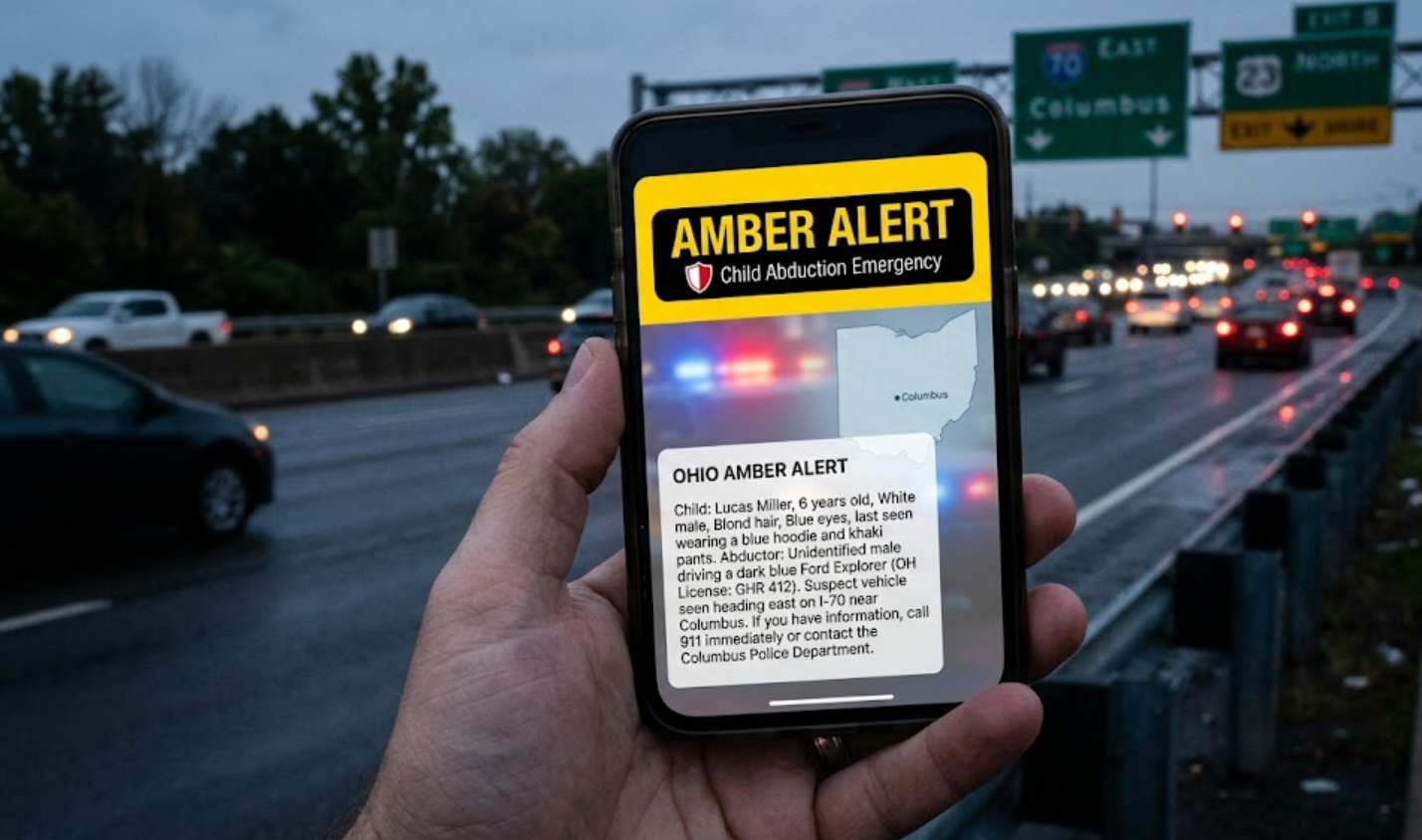
When a child vanishes in Ohio, the seconds, minutes, and hours that follow can mean the difference between a safe homecoming and tragedy. That is precisely why the Amber Alert Ohio system exists — a coordinated emergency notification program that turns ordinary commuters, parents, and neighbors into millions of extra eyes searching for an abducted child. If your phone has ever blared with that unmistakable high-pitched alert tone while driving down I-71 or scrolling at home in Cleveland, Columbus, Cincinnati, Dayton, or Toledo, you have already participated in one of the most successful child-recovery programs in the United States.
This guide breaks down everything Ohio residents need to know about Amber Alerts in 2026 — how the system works, the exact criteria that trigger an alert, recent cases, the alarming statistics, and what you should personally do the moment your device buzzes with one.
What Is an Amber Alert in Ohio?
An Amber Alert is an urgent public bulletin issued by law enforcement when a child has been abducted and is believed to be in immediate, life-threatening danger. The acronym AMBER stands for America’s Missing: Broadcast Emergency Response, and the program was created in 1996 to honor nine-year-old Amber Hagerman, who was kidnapped while riding her bicycle in Arlington, Texas, and later found murdered.
Ohio launched its statewide Amber Alert plan on January 1, 2003. Today, the program is administered through a partnership between the Ohio Attorney General’s office, the Ohio State Highway Patrol, the Ohio AMBER Alert Advisory Committee, local law enforcement agencies, and broadcasters across the state. The Ohio plan is codified in Section 5502.52 of the Ohio Revised Code, which gives it the force of law rather than mere policy.
What sets Amber Alerts apart from a general missing-person notification is intensity. When the system is activated, it taps into the federal Emergency Alert System (EAS) — the same infrastructure used for severe weather and presidential addresses — and pushes a Wireless Emergency Alert (WEA) to every compatible mobile phone inside the targeted area. The goal is simple: galvanize an entire community within minutes.
How the Ohio Amber Alert System Works
Understanding the mechanics of an Ohio Amber Alert helps explain why the system is so effective when it activates — and why it is used so sparingly.
Who Issues an Amber Alert in Ohio
Local law enforcement is the first responder. When a child is reported abducted, the investigating police department or sheriff’s office gathers facts on the ground and contacts the Ohio State Highway Patrol, which is the official issuing authority for statewide Amber Alerts. The Highway Patrol verifies that all activation criteria are met before pressing the proverbial red button.
Once approved, the alert is flagged in the National Crime Information Center (NCIC) database, which simultaneously notifies federal partners, neighboring states, and the Ohio Child Abduction Response Team (CART).
How the Alert Reaches You
Initial activation uses the Emergency Alert System with the Child Abduction Emergency (CAE) code, which interrupts radio, broadcast television, and cable programming. At the same moment, the Wireless Emergency Alert system pushes a notification to every WEA-enabled mobile device within the targeted region — whether that is one county, a multi-county zone, or all 88 Ohio counties.
After the initial blast, secondary notifications continue through:
- Social media posts from law enforcement and the Ohio Attorney General
- Email and text-message subscriptions through OhioAMBERPlan.org
- Electronic highway message boards along Ohio interstates
- Lottery terminal displays at retailers
- Fax broadcasts to media outlets
Residents can view active alert details — including photographs of the child, suspect, and vehicle — at OhioAMBERPlan.org or by calling the toll-free hotline 1-877-AMBER-OH (1-877-262-3764).
Ohio Amber Alert Criteria: When Is One Actually Issued?
This is the single most misunderstood part of the program. Many Ohioans assume that every missing child triggers an Amber Alert. They do not. The Ohio Revised Code lists strict, non-negotiable criteria, and all four must be met before the statewide system can be activated.
1. Law Enforcement Must Confirm an Actual Abduction
A child wandering off, running away, or simply being late from school does not qualify. Police must have evidence that the child was forcibly taken. Without confirmation of an abduction, the case may still receive serious attention — but through a different alert pathway.
2. The Child Must Be Under 18 Years of Age
The Amber Alert program is specifically designed for minors. For missing adults, Ohio uses the Missing Adult Alert (commonly called the Silver Alert).
3. There Must Be a Credible Threat of Serious Bodily Harm or Death
This is the highest legal bar. Investigators need a specific, articulable reason — a weapon, a stated threat, a history of violence, the suspect’s mental state, or the circumstances of the taking — to believe the child faces imminent danger. Mere disappearance is not enough.
4. There Must Be Sufficient Descriptive Information
If police have no description of the abductor, no vehicle make or model, no plate number, and no direction of travel, then a public alert offers little practical help. Investigators need actionable details that the public can recognize on the road or in a parking lot.
A Critical Exception: Family Abductions and Runaways
By default, runaways and custody-dispute abductions by a parent or family member do not trigger an Amber Alert. However, if the investigation reveals that even a family abduction puts the child in immediate danger of serious bodily harm or death, the alert can still be activated.
This is why some heartbreaking cases — including the March 2025 disappearance of 13-year-old Kei’mani Latigue in Toledo — never received a statewide Amber Alert. When the criteria are not fully met, Ohio uses other notification pathways, which we will cover below.
Ohio Amber Alert Statistics: A Snapshot of Recent Years
Looking at the numbers reveals just how rare and targeted these alerts truly are.
According to the Ohio AMBER Alert Advisory Committee, statewide activations have remained relatively low and stable:
- 2026 (year-to-date as of June): 0 statewide activations
- 2025: 3 statewide activations
- 2024: 13 statewide activations
- 2023: 8 statewide activations
- 2022: 6 statewide activations
For context, roughly 15,300 children were reported missing in Ohio during 2024 according to the Ohio Attorney General’s annual missing children report — yet the overwhelming majority were runaways and were recovered quickly without needing an Amber Alert.
Nationally, the program has produced remarkable results. As of December 31, 2025, the U.S. Department of Justice confirms that 1,312 children have been safely recovered as a direct result of an Amber Alert activation, with at least 252 of those rescues attributed specifically to Wireless Emergency Alerts pushed to mobile phones.
Ohio has historically punched above its weight in this system. In 2018, Ohio issued the second-highest number of Amber Alerts in the nation, behind only Texas. In 2023, Ohio again ranked third nationally with 13 alerts.
Ohio’s Other Emergency Alert Programs
Because not every missing-person case meets the strict Amber Alert threshold, Ohio operates a tiered system of complementary alerts. Knowing the difference helps the public respond appropriately when one is issued.
Endangered Missing Child Alert (EMCA)
When a child is missing under suspicious or dangerous circumstances but the case does not meet every Amber Alert criterion — for example, when there is no confirmed abduction but the child has a medical condition, is too young to survive alone, or is otherwise at serious risk — Ohio issues an Endangered Missing Child Alert. EMCAs do not trigger the EAS or WEA blast; instead, they are distributed through social media, email subscribers, news partners, and law enforcement networks.
In 2024 alone, Ohio issued 18 Endangered Missing Child Alerts, more than the number of full Amber Alerts that year.
Missing Adult Alert (Silver Alert)
The Missing Adult Alert program — often called the Silver Alert — covers missing adults with cognitive impairments, including dementia and Alzheimer’s. A 2025 update to Ohio Revised Code § 5502.522 expanded eligibility to include adults with autism and developmental disabilities, broadening the protection significantly for Ohio’s most vulnerable residents.
Ohio Blue Alert
The Blue Alert is activated when a law enforcement officer is killed, seriously injured, or goes missing in the line of duty, and a suspect is at large. Unlike the Amber Alert, the Blue Alert does not activate the EAS or WEA system — it is distributed via social media, email, and text-message subscriptions. A dedicated tip line (1-877-262-3764) is also activated for each case.
Notable Recent Ohio Amber Alert Cases
Behind every Amber Alert is a real family enduring a crisis no parent should ever face. A few recent Ohio cases illustrate the range of outcomes the system delivers.
A 35-Minute Recovery in Cincinnati (January 2024)
In one of the fastest resolutions on record, a child abducted along with a running car in Cincinnati was located within 35 minutes of the alert being issued. This kind of rapid recovery is the system at its very best — public vigilance combined with law enforcement coordination.
The Darnell Taylor Tragedy (February 2024)
Not every Amber Alert ends happily. In February 2024, the Ohio Amber Alert issued for 5-year-old Darnell Taylor ended with the child found deceased and his legal guardian arrested. The case became a sobering reminder that even an active, well-distributed alert cannot guarantee a safe outcome when violence has already occurred.
Twin Infants in Columbus (December 2022)
The abduction of 5-month-old twin boys in Columbus exposed gaps in the system when alert issuance was delayed. The family reportedly called the Ohio State Highway Patrol three times before the alert went live, and both Columbus police and the Highway Patrol later acknowledged the timing was not ideal. The case prompted internal reviews and renewed calls for faster activation protocols.
Whitehall Infant Recovery (2026)
In a recent case, a 1-year-old boy was abducted from a supervised visit at Buckeye Ranch in Whitehall by his mother, who did not have custody. The Amber Alert was cancelled within two hours after both child and suspect were located safely, and the mother was taken into custody.
How Effective Are Amber Alerts in Ohio?
The honest answer is nuanced. Amber Alerts are not a magic solution — but when they fire correctly, they save lives at a rate few public-safety programs can match.
Nationally, in 2023, of 183 Amber Alert cases that led to recovery, 49 children were rescued as a direct result of the alert itself — a roughly 26 percent direct-success rate. About one in four of those direct successes came from members of the public spotting a vehicle described in the alert.
In Ohio specifically, the 2024 Ohio Attorney General’s report confirmed that all four children featured in statewide Amber Alerts that year were recovered safely. Most national Amber Alert recoveries happen within one to three hours of activation, and the same trend holds true in Ohio.
The system works best when:
- The alert is issued quickly after the abduction
- A vehicle description and license plate are available
- The case occurs in a populated corridor with active drivers
- The public takes the alert seriously rather than swiping it away
What to Do When You Receive an Ohio Amber Alert on Your Phone
You are not a passive recipient of an Amber Alert — you are an active participant in the search. Here is exactly what to do when one arrives.
1. Read the Full Alert
The WEA tone is jarring on purpose. Do not dismiss it. Read the entire alert: the child’s name and age, vehicle description, license plate, and the direction of travel.
2. Look Around You — Especially If You’re Driving
Most Amber Alert direct rescues happen because someone driving on a nearby road spotted the suspect vehicle. Glance at the cars around you. Check your rearview mirror. Pay attention at gas stations, rest stops, and parking lots.
3. Do Not Approach the Suspect
If you believe you have spotted the vehicle, do not attempt to stop it, follow it aggressively, or confront the suspect. Abductors are often armed or volatile.
4. Call 911 Immediately
Pull over safely and call 911. Provide the dispatcher with the vehicle’s exact location, direction of travel, plate number, and a description of any occupants. The faster law enforcement gets your tip, the faster they can intercept.
5. Share Through Official Channels
If you cannot help directly, share the alert from official sources — the Ohio State Highway Patrol, Ohio Attorney General, or OhioAMBERPlan.org — to expand its reach. Avoid spreading unverified social-media posts that may contain wrong information.
You can also call 1-877-AMBER-OH (1-877-262-3764) to relay tips or get verified information about an active alert.
How to Sign Up for Ohio Amber Alerts
While Wireless Emergency Alerts are automatic on most modern phones, you can opt in to additional notification channels for more detailed updates.
Visit the Ohio Attorney General’s website or OhioAMBERPlan.org to subscribe to alerts via email and text message. The Ohio Citizen Alert Network — a partnership between the Ohio Bureau of Criminal Investigation and the Ohio AMBER Plan — also offers free sign-up for Amber Alerts, Endangered Missing Child Alerts, Missing Adult Alerts, and Blue Alerts.
You can also follow the Ohio State Highway Patrol and Ohio Attorney General Dave Yost on X (formerly Twitter), Facebook, and Instagram for real-time updates.
Common Misconceptions About Ohio Amber Alerts
“Why didn’t they issue an Amber Alert for that missing kid I saw on the news?” This is the most frequent question asked of Ohio law enforcement, and the answer is almost always the same: the case did not meet the strict legal criteria. The system is intentionally narrow to preserve public attention for the most urgent cases.
“I get too many Amber Alerts on my phone.” Ohio averages between 6 and 13 statewide Amber Alerts per year — far fewer than most people assume. If you feel inundated, you may be receiving alerts from neighboring states as well as in-state alerts.
“Can I turn Amber Alerts off?” Technically yes, on most phones in the settings menu, but doing so is strongly discouraged. The alerts are infrequent, and a single notification could be the lead that saves a child’s life.
“Amber Alerts are mostly false alarms.” They are not. The Ohio Revised Code makes it a criminal offense to knowingly make a false report that triggers the statewide alert system, and confirmed false activations are exceedingly rare.
Frequently Asked Questions About Amber Alert Ohio
What does AMBER stand for in Amber Alert?
AMBER stands for America’s Missing: Broadcast Emergency Response, named after nine-year-old Amber Hagerman, who was abducted and murdered in Arlington, Texas, in 1996.
Who issues Amber Alerts in Ohio?
The Ohio State Highway Patrol issues statewide Amber Alerts, working in coordination with the local law enforcement agency investigating the abduction and the Ohio AMBER Alert Advisory Committee.
What phone number can I call for Amber Alert information in Ohio?
The toll-free hotline is 1-877-AMBER-OH (1-877-262-3764). You can also visit OhioAMBERPlan.org for active alerts and historical case information.
Why are some missing children not given an Amber Alert?
Because the four legal criteria — confirmed abduction, child under 18, credible threat of serious harm, and sufficient descriptive information — must all be met. Cases that fall short may still receive an Endangered Missing Child Alert.
What is the difference between an Amber Alert and an Endangered Missing Child Alert in Ohio?
An Amber Alert activates the federal EAS and WEA systems for confirmed abductions with credible threats. An Endangered Missing Child Alert is used when a child is in danger but the case does not meet every Amber criterion — and it does not trigger phone or broadcast emergency tones.
How many Amber Alerts has Ohio issued?
Ohio averages between 6 and 13 statewide activations per year. In 2025, the state issued three Amber Alerts, while 2024 saw 13.
Are Amber Alerts actually effective?
Yes. As of December 31, 2025, more than 1,312 children have been safely recovered nationally as a direct result of Amber Alert activations, and Ohio’s 2024 cases all resulted in safe recoveries.
Final Thoughts: Your Role in Keeping Ohio’s Children Safe
The Amber Alert Ohio program is one of the rare public-safety systems that genuinely depends on ordinary people doing their part. Law enforcement can issue the alert, broadcasters can amplify it, and lawmakers can fund it — but it is the truck driver on I-75, the parent picking up groceries in Columbus, the teenager scrolling through social media in Akron, and the retiree gassing up in Youngstown who actually spots the vehicle and makes the call that brings a child home.
The next time your phone buzzes with that unmistakable alert tone, do not swipe it away. Read it. Look around. Remember the vehicle and the plate. And if something matches, dial 911. In Ohio, hundreds of children are alive today because someone took those few seconds seriously.
For more information, to view active alerts, or to sign up for notifications, visit OhioAMBERPlan.org or contact the Ohio Attorney General’s office. If you are a parent, take a moment today to teach your children about stranger safety, write down their current physical description, and keep a recent photograph on hand — small steps that, in the worst-case scenario, can shave critical minutes off a search.
For more Update and Entertainment Visit To: Celebrity Ledger